Teaching reading is one of the most vital yet challenging tasks educators face, especially when working with students who struggle with dyslexia or other language-based learning differences. For many years, the traditional methods of teaching phonics and literacy have proven insufficient for these learners, often leaving them feeling frustrated and left behind. This is where the Orton-Gillingham approach steps in, offering a structured, multisensory, and individualized path to literacy success. It’s a highly effective methodology, but its comprehensive nature can feel overwhelming without a clear framework.
Fortunately, having a well-designed orton gillingham lesson plan template can transform this complex teaching method into a manageable and highly effective daily practice. Such a template provides a roadmap, ensuring that every critical component of an Orton-Gillingham lesson is covered systematically, tailored to the unique needs of each student. It helps educators maintain fidelity to the approach while empowering them to adapt and personalize instruction with confidence and ease.
The Core Components of an Effective Orton-Gillingham Lesson
An Orton-Gillingham lesson is far more than just teaching letters and sounds; it’s a meticulously crafted experience designed to build a strong literacy foundation from the ground up. Each session is diagnostic-prescriptive, meaning the teacher constantly assesses the student’s understanding and adjusts the lesson in real time to meet their evolving needs. This individualized attention is what makes the approach so powerful, focusing on the specific areas where a student requires support, rather than a one-size-fits-all curriculum.
The hallmark of an Orton-Gillingham lesson is its multisensory delivery. Students aren’t just hearing or seeing information; they’re also touching, moving, and actively engaging with the material. This simultaneous use of visual, auditory, and kinesthetic-tactile pathways helps solidify learning and create stronger neural connections, which is particularly beneficial for learners who struggle with traditional rote memorization. The structure is cumulative, building new skills upon previously mastered concepts, ensuring no gaps in learning.
Lessons typically follow a predictable sequence, providing a sense of comfort and routine for the student while systematically addressing various aspects of language. This includes everything from phonological awareness activities, which focus on the sounds of language, to more advanced concepts like morphology and etymology, exploring word origins and structures. The consistent structure also helps teachers remember all the necessary components without missing any crucial steps.
The diagnostic-prescriptive nature allows for immediate feedback and adjustments. If a student struggles with a particular concept, the teacher can immediately re-teach it using different multisensory techniques or revisit previously covered material until mastery is achieved. This flexible yet structured approach is key to accelerating progress and building confidence in struggling readers and writers.
Building Foundational Skills
Every Orton-Gillingham lesson begins by reinforcing foundational skills. This often includes a review of previously learned phonograms, which are letters or letter combinations representing specific sounds. Students might practice tracing letters while saying their sounds, building automaticity and reinforcing the connection between the visual symbol and its auditory counterpart. Phonological awareness exercises, such as segmenting words into sounds or blending sounds to form words, are also critical components that strengthen the auditory processing necessary for reading.
Decoding and Encoding Practice
The heart of an OG lesson lies in its explicit instruction in decoding and encoding. Decoding involves reading words by breaking them down into their individual sounds and blending them together. Students learn specific rules and patterns for syllable division, vowel sounds, and consonant blends. Encoding, or spelling, is taught simultaneously, reinforcing the same concepts from a different angle. Students will practice spelling words by segmenting sounds and writing the corresponding letters, often using multisensory methods like “finger spelling” or writing in sand trays.
Fluency and Comprehension Integration
Beyond just basic decoding, Orton-Gillingham lessons integrate fluency and comprehension. Once students can decode words accurately, they move towards reading smoothly and with expression. This is often achieved through repeated readings of controlled text that aligns with their learned phonogram skills. Comprehension is woven into every aspect, as students are taught to understand what they read by discussing vocabulary, making connections, and summarizing passages. This holistic approach ensures that students not only read words but also grasp their meaning.
Why Use an Orton-Gillingham Lesson Plan Template?
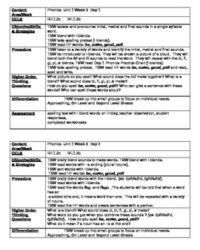
Implementing the Orton-Gillingham approach effectively requires precision and consistency. For educators, especially those new to the methodology or balancing multiple students with varying needs, remembering every component and ensuring proper pacing can be challenging. This is where an orton gillingham lesson plan template becomes an indispensable tool. It provides a structured framework that guides the teacher through each segment of the lesson, ensuring that no essential element is overlooked and that the multisensory, diagnostic-prescriptive principles are consistently applied.
Using a template significantly streamlines lesson preparation. Instead of crafting each lesson from scratch, teachers can focus their energy on tailoring the content to individual student needs rather than remembering the structural flow. It acts as a checklist, helping educators maintain the integrity of the Orton-Gillingham sequence while still allowing ample room for personalization. This balance of structure and flexibility is crucial for delivering effective, responsive instruction that truly makes a difference in a student’s literacy journey.
Moreover, a well-designed template promotes consistency across lessons and even across different educators if a school or team is implementing the program. This uniformity ensures that students receive a cohesive and predictable learning experience, which is particularly beneficial for those who thrive on routine. It also serves as a valuable record of progress, allowing teachers to easily track what has been taught, what has been mastered, and what needs further review, making long-term planning and student assessment much more efficient.
* Ensures Comprehensive Coverage
* Promotes Consistency and Structure
* Saves Preparation Time
* Facilitates Progress Tracking
* Supports Individualized Instruction
The thoughtful application of the Orton-Gillingham methodology can profoundly transform a student’s relationship with reading and writing, turning struggle into success. By providing a clear and comprehensive blueprint, a dedicated template empowers educators to deliver these impactful lessons with confidence and precision. It simplifies the planning process, allowing more time and energy to be directed towards the actual act of teaching and student interaction.
Ultimately, this systematic approach, guided by a well-structured template, helps unlock the literacy potential in every learner. It provides the necessary tools and framework for teachers to deliver the explicit, multisensory, and diagnostic instruction that is so critical for students with language-based learning differences. Embracing such a resource is a powerful step towards building confident, capable readers and writers for life.