Ever feel like your lessons could use a bit more… structure? You know, something that really helps students grasp complex ideas, rather than just memorizing facts? That is where the incredible 5 Es instructional model comes into play. It is a fantastic framework designed to guide students through a learning experience in a way that is logical, interactive, and deeply engaging. It is not just about teaching content; it is about fostering a deeper understanding and encouraging active participation.
This model moves beyond traditional lectures, inviting students to actively construct their own understanding of concepts. By following its five distinct phases, educators can create dynamic lessons that resonate with learners of all styles, truly making knowledge stick. A well-designed 5 es lesson plan template becomes an indispensable tool for any educator aiming to build powerful, memorable learning journeys in their classroom.
Understanding the Core of the 5 Es Model
The 5 Es instructional model is a constructivist approach to learning, meaning it is built on the idea that learners construct their own understanding from experience. Instead of simply receiving information, students are encouraged to engage with it, explore it, explain it in their own words, elaborate on it, and finally, evaluate their understanding. This sequential process ensures a comprehensive learning experience that goes beyond rote memorization, fostering critical thinking and problem-solving skills.
Each “E” represents a specific phase of learning, guiding both the teacher and the student through a structured yet flexible pathway. This model is particularly effective in science and math education, but its principles are universally applicable across all subjects, from language arts to social studies. It provides a clear roadmap for lesson development, ensuring that no crucial step in the learning process is overlooked.
Let us dive into what each of these powerful Es entails, and how they collectively form a cohesive and effective teaching strategy.
Engage
This is the hook. The Engage phase aims to capture students attention, pique their curiosity, and activate their prior knowledge. The goal here is not to teach content, but to establish a connection to the new material. Activities might include thought-provoking questions, a short video, a real-world problem, or a brief discussion that gets students thinking about the topic at hand. This initial spark is crucial for setting the stage for deeper learning.
Explore
In the Explore phase, students actively investigate the concepts. This is where hands-on activities, experiments, data collection, or research take place. Teachers act as facilitators, guiding students as they work collaboratively or individually to discover new ideas and relationships. This phase allows students to gather concrete experiences that will later form the basis for their conceptual understanding. It is about discovery and first-hand interaction with the subject matter.
Explain
The Explain phase is where students articulate their understanding based on their experiences from the Explore phase. Teachers introduce formal terms, definitions, and concepts to help students make sense of what they observed. This is often a teacher-led discussion, mini-lecture, or student presentations where new vocabulary and scientific principles are explicitly introduced. It is the moment for clarifying misconceptions and solidifying the knowledge gained during exploration.
Elaborate
Once students have a foundational understanding, the Elaborate phase challenges them to apply their new knowledge in new situations. This could involve solving more complex problems, conducting further investigations, designing experiments, or creating projects that extend their learning. It helps students generalize their understanding and apply it to real-world contexts, demonstrating mastery and connecting concepts to broader themes. This phase truly reinforces learning and promotes critical thinking.
Evaluate
The final phase, Evaluate, allows both teachers and students to assess understanding. This is where students demonstrate what they have learned, and teachers can gauge the effectiveness of their instruction. Assessment can take many forms, including traditional tests, projects, presentations, journals, or observations of student performance during the Elaborate phase. It provides valuable feedback for future instruction and helps students reflect on their own learning journey.
Crafting Your Ideal 5 Es Lesson Plan Template
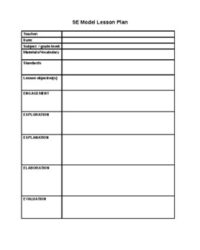
Developing your own 5 es lesson plan template can significantly streamline your lesson planning process and ensure consistency in your teaching approach. A well-structured template acts as a checklist, prompting you to consider all necessary elements for a truly effective lesson. It helps you visualize the flow of your lesson from engagement to evaluation, ensuring that each phase builds logically upon the last.
Think of your template not as a rigid rulebook, but as a flexible framework that you can adapt to suit different subjects, grade levels, and student needs. It empowers you to focus on the content and student interactions, rather than getting bogged down in the structural details. Having a reliable template means you are always prepared to deliver a high-quality, student-centered learning experience.
Here are some key elements to consider when building or customizing your own template, ensuring it serves as a powerful tool for your classroom:
- Lesson Title and Subject Area
- Grade Level and Time Allotment
- Learning Objectives (What students will know or be able to do)
- Materials Needed for Each Phase
- Description of Activities for Engage Phase
- Detailed Plan for Explore Phase Activities
- Key Concepts and Vocabulary for Explain Phase
- Application Scenarios for Elaborate Phase
- Assessment Methods for Evaluate Phase
- Differentiation Strategies (for diverse learners)
Implementing the 5 Es model transforms the classroom into a dynamic, student-centered environment. It encourages students to take ownership of their learning, fostering curiosity and a deep conceptual understanding that extends far beyond the classroom walls. By systematically guiding learners through engagement, exploration, explanation, elaboration, and evaluation, educators can unlock a new level of academic success and genuine intellectual curiosity.
This comprehensive approach ensures that learning is not just about memorizing facts, but about building meaningful connections and developing essential skills for lifelong inquiry. Embracing the 5 Es framework in your daily lesson planning is a step towards creating truly impactful and unforgettable educational experiences for every student.